It has been a while since my last blog post. I have been busy for the past few months. Anyway, I thought I would resume. And I thought the best way to resume is to post something very cool, interesting and totally unexpected.
">
Showing posts with label Science. Show all posts
Showing posts with label Science. Show all posts
Tuesday, February 23, 2010


Monday, May 25, 2009
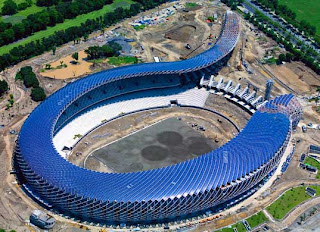
Taiwan's New Solar Stadium - Amazing
From Inhabitat: Taiwan’s Solar Stadium is 100% Powered by the Sun by Diane Pham
Taiwan recently finished construction on an incredible solar-powered stadium that will generate 100% of its electricity from photovoltaic technology! Designed by Toyo Ito, the dragon-shaped 50,000 seat arena is clad in 8,844 solar panels that illuminate the track and field with 3,300 lux. The project will officially open later this year to welcome the 2009 World Games.
Building a new stadium is always a massive undertaking that requires millions of dollars, substantial physical labor, and a vast amount of electricity to keep it operating. Toyo Ito’s design negates this energy drain with a stunning 14,155 sq meter solar roof that is able to provide enough energy to power the stadium’s 3,300 lights and two jumbo vision screens. To illustrate the incredible power of this system, officials ran a test this January and found that it took just six minutes to power up the stadium’s entire lighting system!


Read more here.
Taiwan recently finished construction on an incredible solar-powered stadium that will generate 100% of its electricity from photovoltaic technology! Designed by Toyo Ito, the dragon-shaped 50,000 seat arena is clad in 8,844 solar panels that illuminate the track and field with 3,300 lux. The project will officially open later this year to welcome the 2009 World Games.
Building a new stadium is always a massive undertaking that requires millions of dollars, substantial physical labor, and a vast amount of electricity to keep it operating. Toyo Ito’s design negates this energy drain with a stunning 14,155 sq meter solar roof that is able to provide enough energy to power the stadium’s 3,300 lights and two jumbo vision screens. To illustrate the incredible power of this system, officials ran a test this January and found that it took just six minutes to power up the stadium’s entire lighting system!


Read more here.
Saturday, April 11, 2009
This Week in Science: Bonnie Bassler: Discovering Bacteria's Amazing Communication System
Bonnie Bassler discovered that bacteria "talk" to each other, using a chemical language that lets them coordinate defense and mount attacks. The find has stunning implications for medicine, industry -- and our understanding of ourselves.
About Bonnie Bassler: In 2002, bearing her microscope on a microbe that lives in the gut of fish, Bonnie Bassler isolated an elusive molecule called AI-2, and uncovered the mechanism behind mysterious behavior called quorum sensing -- or bacterial communication. She showed that bacterial chatter is hardly exceptional or anomolous behavior, as was once thought -- and in fact, most bacteria do it, and most do it all the time. (She calls the signaling molecules "bacterial Esperanto.")
The discovery shows how cell populations use chemical powwows to stage attacks, evade immune systems and forge slimy defenses called biofilms. For that, she's won a MacArthur "genius" grant -- and is giving new hope to frustrated pharmacos seeking new weapons against drug-resistant superbugs.
Bassler teaches molecular biology at Princeton, where she continues her years-long study of V. harveyi, one such social microbe that is mainly responsible for glow-in-the-dark sushi. She also teaches aerobics at the YMCA.
Sunday, March 29, 2009
This Week in Science: Relativity and Quantum Mechanics
From the New York Times: Sons of Atom by Peter Galison
Read more here.
The first quarter of the 20th century produced two theories, Relativity and Quantum Mechanics, that are still changing our universe.
With special relativity, Albert Einstein upended the long-understood meaning of time, space and simultaneity. With general relativity, he swapped Newton’s law of gravity based on force for curved spacetime, and cosmology became a science. Just after World War I, relativity made front-page news when astronomers saw the Sun bend starlight. Overnight, Einstein became famous as no physical scientist before or since, his theory the subject of poetry, painting and architecture.
Then, with the development of quantum mechanics in the 1920s, physics got really interesting. Quantum physics was a theory so powerful — and so powerfully weird — that nearly a century later, we’re still arguing about how to reconcile it with Einsteinian relativity and debating what it tells us about causality, locality and realism.
Relativity leads to a world far from every day intuition. But relativity was still classical physics: classical in the sense that it was as causal, maybe even more so, as the physics of Newton. The relativist could defend the view that we could refine our local specification of the state of things now — that we could spell out what every last particle was up to — and then predict the future, as accurately as wanted. Back in the Enlightenment, Pierre-Simon de Laplace imagined a machine that could calculate the future. He didn’t know relativity, of course, but you could imagine a Laplace 2.0 (with relativity) that kept his predictive dream alive.
Quantum mechanics shattered that Laplacian vision. From 1925 to 1927, Niels Bohr, Werner Heisenberg, Erwin Schrödinger, Max Born and many others made the theory into a toolkit that could be used to calculate how copper conducted electricity, how nuclei fissioned, how transistors worked. Quantum mechanics was easy to use, but hard to understand. For example, two particles that interacted might subsequently fly to opposite sides of the solar system, and still act as if they were dependent. Measuring one near Pluto affected measurements as the other zipped by Mercury. Einstein viewed this inseparability, now known as “entanglement,” as the fatal mark of the incompleteness of quantum mechanics: he sought a successor theory that would be local, realist and therefore complete.
Read more here.
Sunday, March 22, 2009
This Week in Science: Discovery of a Monstrous Jurassic Reptile of the Deep
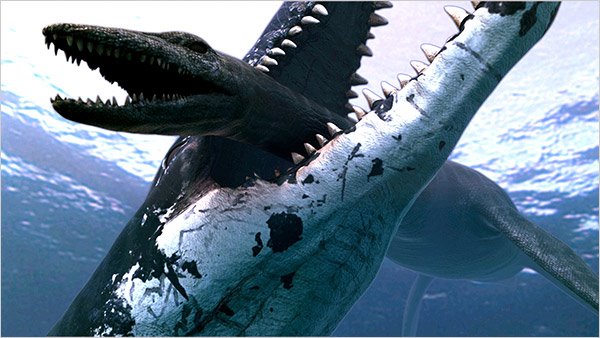
From the New York Times: From Arctic Soil, Fossils of a Goliath That Ruled the Jurassic Seas by: John Noble Wilford
There were monstrous reptiles in the deep, back in the time of dinosaurs.
They swam with mighty flippers, two fore and two hind, all four accelerating on attack. In their elongated heads were bone-crushing jaws more powerful than a Tyrannosaurus rex’s. They were the pliosaurs, heavyweight predators at the top of the food chain in ancient seas.
Much of this was already known. Now, after an analysis of fossils uncovered on a Norwegian island 800 miles from the North Pole, scientists have confirmed that they have found two partial skeletons of a gigantic new species, possibly a new family, of pliosaurs.
This extinct marine reptile was at least 50 feet long and weighed 45 tons, the largest known of its kind. Its massive skull was 10 feet long, and the flippers, more like outsize paddles, were also 10 feet. The creature — not yet given a scientific name but simply called the Monster or Predator X — hunted the seas 150 million years ago, in the Jurassic Period.
“Everything we are finding is new to science,” said Jorn H. Hurum, a paleontologist at the University of Oslo who directed the excavations on the Arctic island of Spitsbergen in the Svalbard archipelago. He described new details of the find in a telephone interview last week.
Dr. Hurum said that in the Jurassic Period, Spitsbergen was covered by the then-temperate waters of a deep ocean. In 2006, the expedition began finding a variety of marine fossils, including pieces of the pliosaur skull, weathering out of a mountainside patrolled by polar bears. A year later, the university announced, the team came upon a flipper and much of the first pliosaur specimen.
But only after excavating the second specimen in last summer’s expedition and comparing the two were the scientists prepared to describe their findings about the huge pliosaur’s anatomy and probable physiology and hunting strategy. This was reported in recent science meetings, and Dr. Hurum said a full description would be published next year in a journal.
More here.
Wednesday, March 18, 2009
Fossil Hints at Fuzzy Dinosaurs

From BBC News: A discovery in China has prompted researchers to question the scaly image of dinosaurs.
Previously, experts thought the first feathered dinosaurs appeared about 150 million years ago, but the find suggests feathers evolved much earlier. This has raised the question of whether many more of the creatures may have been covered with similar bristles, or "dino-fuzz".
The team describe the fossil in the journal Nature.
Hai-Lu You, a researcher from the Insitute of Geology in Beijing, was part of the team that discovered the fossil.
He told BBC News he was "very excited" when he realised the significance of what his team had found.
He described the filaments seen on the body of the new dinosaur, which the team has named Tianyulong confuciusi, as "protofeathers" - the precursors of modern feathers.
"Their function was probably display, as well as to keep the body warm" he said.
Dr You's team noticed that the filaments on the base of their dinosaur's tail were extremely long.
These, they suggest, might have evolved for show, and may even have been coloured.
"The world of dinosaurs would [have been] more colourful and active than we previously imagined," he said.
More here.
Saturday, February 28, 2009
Solving a 17th Century Crime
Forensic anthropologists at the National Museum of Natural History find answers to a colonial cold case.

From the Smithsonian Magazine: Solving a 17th Century Crime by Joseph Caputo
More here.

From the Smithsonian Magazine: Solving a 17th Century Crime by Joseph Caputo
The boy does not have a name, but he is not unknown. Smithsonian scientists reconstructed his story from a skeleton, found in Anne Arundel County, Maryland, buried underneath a layer of fireplace ash, bottle and ceramic fragments, and animal bones.
Resting on top of the rib cage was the milk pan used to dig the grave. "It's obviously some sort of clandestine burial," says Kari Bruwelheide, who studied the body. "We call it a colonial cold case."
Bruwelheide is an assistant to forensic anthropologist Douglas Owsley. After more than a decade of cases that span the centuries, the duo has curated "Written in Bone: Forensic Files of the 17th-Century Chesapeake," on view at the Smithsonian National Museum of Natural History through February 2011. The exhibit shows visitors how forensic anthropologists analyze bones and artifacts to crack historical mysteries. "The public thinks they know a lot about it, but their knowledge is based on shows like ‘Bones' and ‘CSI,' so they get a lot of misinformation," Owsley says. "This is an opportunity for us to show the real thing."
More here.
Friday, February 13, 2009
A Christian Progressive Happy Birthday to Charles Darwin
Yesterday, February 12, marked the 200th birthday of Charles Darwin. The naturalistic view of life that Darwin introduced during his time has changed the way we see our world. His controversial theory of evolution through natural selection has survived for 150 years, amidst the constant deluge of attacks from conservative religious groups and theologians, and has become the foundation of the many new biological sciences we know today.
I found this very interesting article on the Washington post yesterday about a christian progressive's view of Charles Darwin. It talks about the clash between Theology and Darwinism. It is a very good article, and well worth reading.
From the Washington Post: A Christian Progressive Happy Birthday to Charles Darwin
Read more. It is very good.
I found this very interesting article on the Washington post yesterday about a christian progressive's view of Charles Darwin. It talks about the clash between Theology and Darwinism. It is a very good article, and well worth reading.
From the Washington Post: A Christian Progressive Happy Birthday to Charles Darwin
In my own work as a Christian progressive, I have found evolutionary biology, and especially the Human Genome Project, a source of rich dialogue between theology and science. As we celebrate the 200th anniversary of the birth of Charles Darwin, however, the norm for the relationship between religion and science is anything but productive and respectful. Instead, anti-Darwinist views in conservative and even moderate-to-conservative Christianity have been increasing, especially in the last quarter century.
As a Christian, an advocate of human rights, and a person strongly committed to democratic ideals, I believe Darwin's work was of consummate importance for human progress. I further believe that religious progressives need to speak out more directly against a religious campaign against evolutionary biology. We need to say clearly that this targeting of evolution by conservative Christianity is far more political in origin than it is purely theological.
There is no doubt that Darwin's legacy in science has been vast; the theory of natural selection that gave rise to the Darwinian revolution underlies both theory and method in science. The Darwinian upheaval is just this: the origin of species is bottom up, through natural forces, rather than top-down and fixed like conservative Christian theology in particular would contend.
This is where all the trouble arises. The idea that human life is continuous with other creatures and indeed with the whole planet is a profoundly destabilizing idea for religious and political practices of dominance and control. This whole struggle is more about politics than it is about abstract issues like religious faith and secularism. In the 200 years since Charles Darwin's birth, this has changed very little.
Read more. It is very good.
Thursday, February 12, 2009
Happy Birthday Chuck!

Today marks the 200th birthday of Charles Darwin. The naturalistic view of life that Darwin introduced during his time has changed the way we see our world. His controversial theory of evolution through natural selection has survived for 150 years, and has become the basis or foundation of the many new biological sciences we know today. Olivia Judson of the New York Times on the great man.
Before the “Origin,” similarities and differences between species were mere curiosities; questions as to why a certain plant is succulent like a cactus or deciduous like a maple could be answered only, “Because.” Biology itself was nothing more than a vast exercise in catalog and description. After the “Origin,” all organisms became connected, part of the same, profoundly ancient, family tree. Similarities and differences became comprehensible and explicable. In short, Darwin gave us a framework for asking questions about the natural world, and about ourselves.
He was not right about everything. How could he have been? Famously, he didn’t know how genetics works; as for DNA — well, the structure of the molecule wasn’t discovered until 1953. So today’s view of evolution is much more nuanced than his. We have incorporated genetics, and expanded and refined our understanding of natural selection, and of the other forces in evolution.
But what is astonishing is how much Darwin did know, and how far he saw.
Read Olivia Judson's opinion piece on the NYT here. It is very good.
Subscribe to:
Posts (Atom)


 Posts


